The global cleaning and detergent industry is entering a new era. Sustainability is no longer a niche selling point—it has become a core purchasing criterion for consumers, retailers, and distributors worldwide. As we move into 2026, private label eco-friendly cleaning products stand out as one of the fastest-growing and most profitable segments in the market.
From biodegradable formulas to refill systems and low-waste packaging, brands are redefining how cleaning products are formulated, produced, and delivered. At the center of this transformation lies private label and contract manufacturing, enabling companies to respond quickly to changing consumer expectations.
Why Eco-Friendly Cleaning Products Are Growing Rapidly
Several global forces are accelerating demand for sustainable cleaning solutions:
Increased environmental awareness among consumers
Stricter regulations in the EU and other markets
Rising plastic waste concerns
Demand for safer products for children, pets, and sensitive skin
Retail pressure to reduce carbon footprint
As a result, eco-friendly cleaning products are no longer limited to specialty stores. They are now mainstream across supermarkets, online marketplaces, and private brands.
What Makes a Cleaning Product Eco-Friendly?
Eco-friendly cleaning products are defined by both ingredients and product design. Common characteristics include:
Biodegradable formulas that break down naturally in the environment
Plant-based surfactants instead of petroleum-derived chemicals
Mineral-based builders and natural acids
Non-toxic, low-irritation profiles
Vegan and cruelty-free formulations
Reduced or recyclable packaging
Many eco-friendly products also focus on concentrated formats, refill sachets, or powder systems to minimize waste and logistics impact.
Why Private Label Is Driving This Growth
Private label manufacturing allows brands to enter the eco-friendly market faster and more cost-effectively than developing products from scratch.
Key advantages include:
1. Speed to Market
Brands can launch new eco-friendly products quickly using existing formulations and production infrastructure.
2. Cost Efficiency
Private label production significantly lowers R&D, tooling, and operational costs, improving margins.
3. Customization
Formulas, fragrances, packaging, and certifications can be tailored to target markets.
4. Scalability
Production volumes can grow in line with demand, making private label ideal for both startups and large retailers.
Top Eco-Friendly Product Categories for 2026
In 2026, the strongest growth is expected in the following private label categories:
Biodegradable laundry detergents
Eco-friendly dishwashing liquids
Multi-purpose surface cleaners
Refill powder and sachet systems
Concentrated cleaning products
Fragrance-free and sensitive-skin cleaners
Refill and concentrated products are particularly attractive because they combine sustainability with strong economic advantages.
Contract Manufacturing: A Strategic Advantage
Contract manufacturing enables brands to focus on branding, sales, and distribution while production is handled by experienced manufacturers.
Leading manufacturers offer:
Formula development and testing
Regulatory-compliant production
Flexible MOQ options
Private label packaging and branding
Export-ready documentation
This model reduces risk while ensuring consistent quality and supply.
Why Turkey Is a Preferred Manufacturing Hub
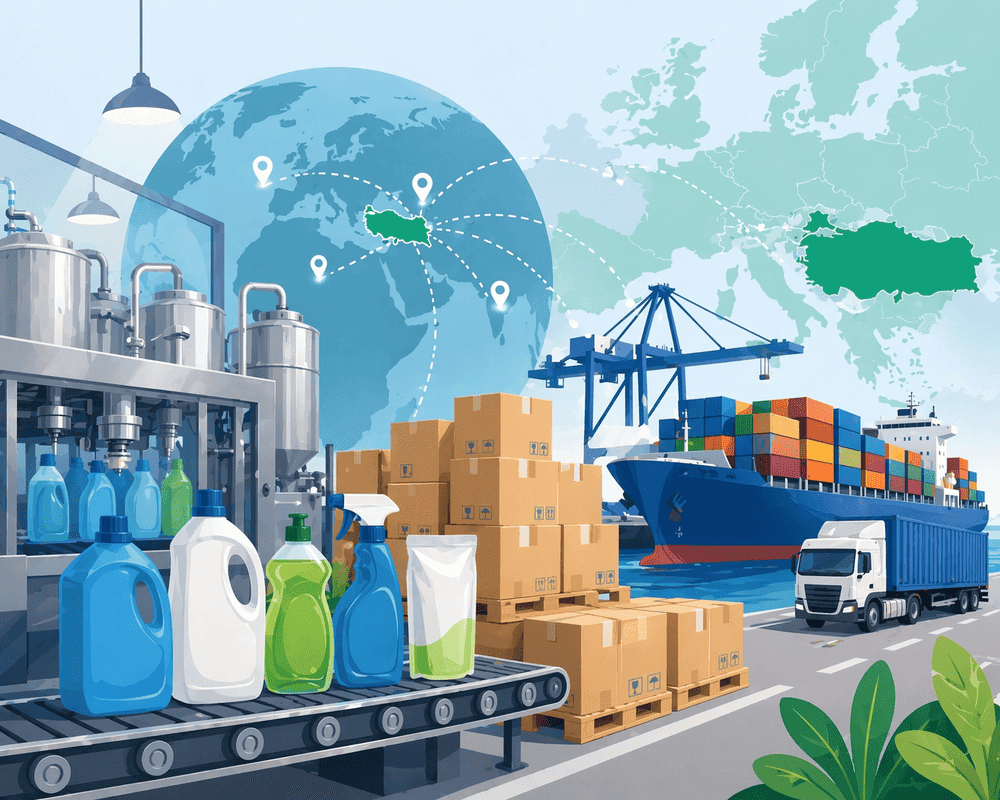
Turkey has emerged as a strategic production center for private label eco-friendly cleaning products.
Key advantages include:
EU Customs Union Benefits
Exports from Turkey to the European Union benefit from zero or near-zero customs duties, offering a clear pricing advantage.
Competitive Production Costs
Lower labor and operational costs compared to Western Europe improve profitability without compromising quality.
Advanced Manufacturing Infrastructure
Turkey has a long-standing expertise in detergent and chemical production, supported by modern facilities.
Strategic Location
Fast and cost-effective logistics to Europe, the Middle East, and the United States.
Lower Import Duties for the U.S.
Compared to many manufacturing regions, Turkish-origin cleaning products often face lower U.S. import duties, making them competitive in the American market.
Why 2026 Will Be a Turning Point
By 2026, sustainability will shift from being a “value-added feature” to a minimum market requirement. Brands that fail to adapt risk losing shelf space, online visibility, and consumer trust.
Private label eco-friendly cleaning products offer the ideal balance of:
Sustainability
Cost control
Market speed
High margins
This is why retailers, distributors, and emerging brands are rapidly expanding their eco-friendly private label portfolios.
Conclusion
Private label eco-friendly cleaning products represent one of the strongest growth opportunities in the cleaning industry for 2026. With increasing regulatory pressure and rising consumer expectations, brands that invest early in sustainable formulations and private label manufacturing will gain a decisive competitive edge.
Turkey, with its strategic location, cost advantages, and advanced manufacturing capabilities, is well positioned to support this global shift.